About us
From adult literacy classes to an inclusive centre
Embosom Special Education Centre grew out of one teacher's conviction that literacy and learning belong to everyone — adults who were never taught to read, and children whom ordinary schools were not built to include.
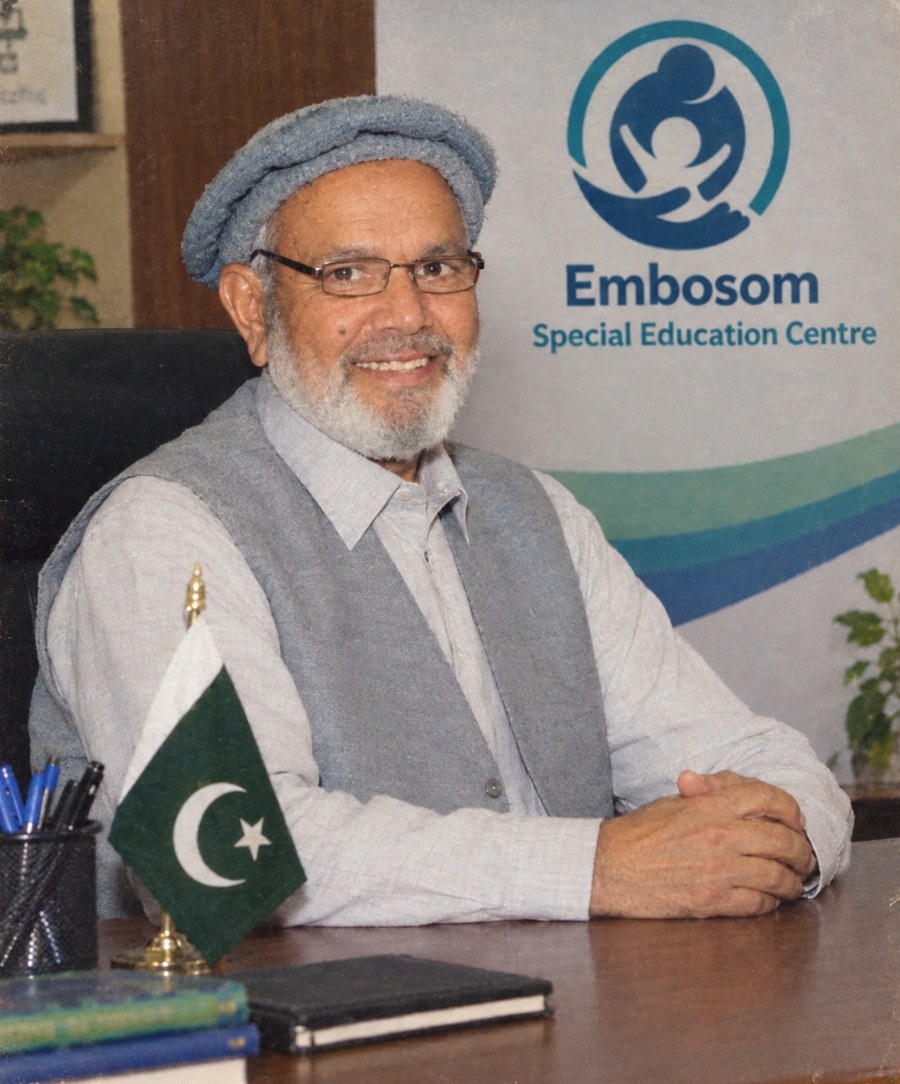
Our founder
A teacher who began with those the system had missed
Syed Majeed Gilani began his working life in Taleem-e-Balighan, the government's adult literacy programme — sitting with grown men and women who had never been given the chance to read, and teaching them their first words on a page. It is unglamorous work. It is also the work that tells you, very quickly, what happens to a person when education passes them by.
That conviction — that no one should be left outside the classroom — became the thread running through everything that followed.
If a child cannot come to the lesson in the usual way, the lesson has to learn to come to the child.
In 1990 he founded his own educational institute in Faisalabad, offering general education to children in the surrounding community. For two decades it did what good neighbourhood schools do: taught, examined, and sent children on their way.
But some children arrived who did not fit the usual shape of a classroom. Children who did not speak on time. Children who could not hear the lesson. Children whose behaviour was read as disobedience when it was, in fact, a difficulty nobody had named. In most schools, these children quietly stopped coming.
In 2010, rather than let that happen, the institute changed its own shape. It became an inclusive education programme — and took the name Embosom: to hold close, to take into one's care. Special education, speech and language therapy, and behavioural support were built in alongside academics, so that a child with additional needs would not have to be sent elsewhere, or sent home.
Today the Centre continues that work under the same principle it started with. Every child who comes through the door is assessed carefully, taught individually, and treated as capable of more than they arrived with.
Our story
How Embosom came to be
-
Early career
Taleem-e-Balighan
Syed Majeed Gilani teaches in the Government Adult Literacy Programme, working with adults who never had access to schooling.
-
1990
A school of his own
He founds an independent educational institute in Faisalabad, providing general education to children in the local community.
-
2010
Embosom Special Education Centre
The institute is restructured as an inclusive education programme, adding special education, therapy, and individualised support for children with additional needs.
-
Today
A multidisciplinary centre
Speech and language pathology, Applied Behaviour Analysis, special education, and parent training, delivered by a qualified team under one roof.
Who we are today
Embosom Special Education Centre supports children across a wide range of profiles: autism spectrum disorder, expressive and receptive language disorders, articulation and phonological difficulties, apraxia, feeding difficulties, hearing impairment, and broader learning and developmental delays.
Our team works across disciplines — special education, speech and language pathology, and behaviour therapy — so that a child is seen as a whole person rather than a list of separate problems.
Parents are treated as partners in that work, not bystanders. What happens in a therapy room matters; what happens in the hours between sessions matters more.
What guides our work
- Evidence-basedAssessment and intervention grounded in current, researched practice.
- IndividualisedEvery plan is written for one child, with goals we can measure.
- Family-centredParents are coached, informed, and involved at every stage.
- InclusiveWe prepare children to take part — at school, at home, in their community.
- EthicalHonest reporting of progress, and referral onward when that serves the child best.
Our approach
Assess carefully. Plan clearly. Measure honestly.
Therapy works when it is specific. We start by understanding exactly where a child is, then build forward from there in small, trackable steps.
Comprehensive assessment
Standardised and observational assessment of speech, language, communication, behaviour, and learning — alongside a full developmental and medical history taken from the family.
Individualised Education Plans
Written goals for communication, academic, social, and behavioural development, agreed with parents and reviewed on a set schedule.
Multidisciplinary practice
Educators, therapists, and behaviour specialists working from the same plan, with co-treatment sessions where a child benefits from both at once.
Parent training
Practical, demonstrated strategies parents can use at home, because the hours between sessions are where most progress is won.
Inclusion focus
Preparing children for mainstream classrooms where appropriate, and supporting schools and teachers to receive them well.
Ongoing measurement
Progress recorded session by session, so decisions about what to continue, change, or stop are based on data rather than impressions.
Our team
Qualified, certified, and continually training
Our practitioners hold postgraduate qualifications in speech & language pathology, special education, and public mental health, with certified training in Applied Behaviour Analysis, IEP development, autism management, and support for children with hearing loss.
Come and see the Centre
The best way to know whether we are right for your child is to visit, meet the team, and ask us anything.
Arrange a Visit